What a House, a Tree, and a Person Say About You
The house tree person test reveals what you'd never put into words — a drawing gets past the answers you've already rehearsed.

Ask a stressed person how they're doing and you'll get one word back. Fine. Busy. Good. We've rehearsed those answers so many times they come out before we've stopped to ask whether they're true.
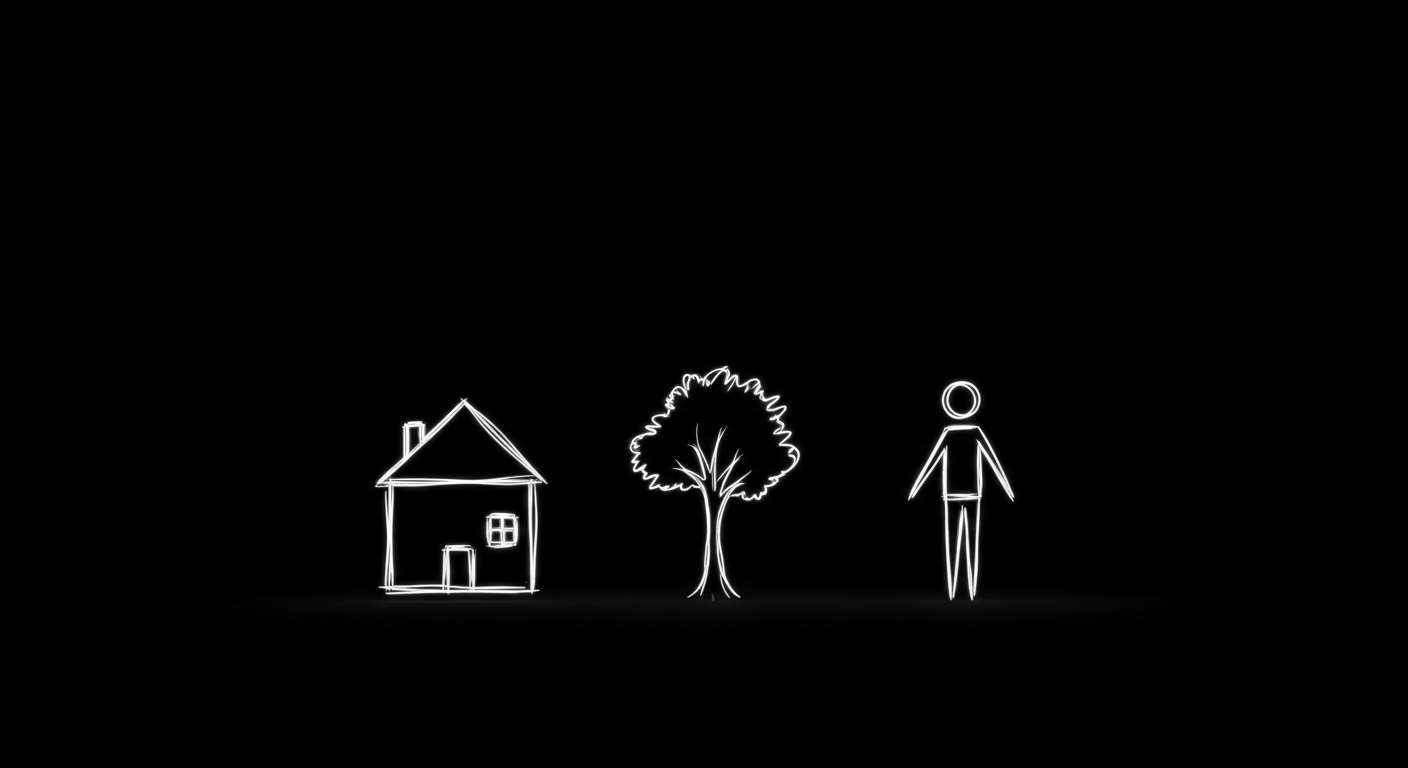
Now hand that same person a blank page and ask them to draw a house, a tree, and a person. Something shifts. There's no rehearsed answer for a drawing. That's the quiet idea behind the house tree person test, a method clinicians have used since 1948 to see what someone can't, or won't, put into words.
It sounds almost too simple to work. Three ordinary objects. A pencil. No questions about your childhood, no rating your mood from one to ten. And yet what ends up on that page tends to be more honest than anything you'd type into a form.
I think that's because nobody guards a drawing the way they guard their words. We've learned which answers keep a conversation short and which ones invite a follow-up nobody has time for. A drawing slips under all of that, because it never feels like a report. It feels like drawing a house.
And the house, it turns out, has a lot to say. So do the tree and the person standing next to it.
What the House-Tree-Person Test Actually Measures
The House-Tree-Person test is a projective psychological assessment, created in 1948, that asks you to draw a house, a tree, and a person. Clinicians read the drawings (proportions, placement, pressure of the line, the details you add and the ones you leave out) as clues to how you see yourself, your relationships, and the world you move through.
"Projective" is the word doing the real work there. It means the test doesn't ask you a question and score your answer. It gives you something open-ended and watches what you bring to it. The page is neutral. Everything that lands on it came from you.
It came out of clinical psychology, not a magazine. A psychologist named John Buck developed it in the late 1940s as a way to understand patients who struggled to talk about themselves: children, people in distress, anyone for whom words were the hard part. He needed a read that didn't depend on a good interview. The drawing gave him one. Nearly eighty years later, it's still taught and still used, which is rare for any psychological tool. Most don't survive a decade.
That's a different kind of measurement than most of us are used to. A survey can only record what you're willing to say about yourself. A drawing catches the decisions you make when there's no right answer to perform, and those decisions are far harder to fake.
The house tends to map to your sense of home and security: the life you've built and how safe it feels. The tree often reflects your deeper sense of self, the part that grew slowly over years. The person points to how you see yourself in relation to others. None of it is a fortune cookie. Good clinicians have treated it as the start of a conversation from the beginning.
Why a Drawing Gets Past Your Defenses
Here's the part that surprises people. The less artistic you are, the more honest the drawing usually is.
When you can't fall back on technique, you fall back on instinct. You draw the house the way it lives in your head, not the way a house is "supposed" to look. The size you make it, where you put it on the page, whether it has a door you could walk through: those choices happen below the level of decision. There's no curating in any of it. The page gets whatever your instinct hands over.
I watched this happen with a friend once. He'd spent a dinner insisting work was great, never better. Then someone passed him a napkin and asked him to sketch his house, half as a joke. He drew it tiny, crammed into the bottom corner, no door. He laughed it off. But he went quiet for a second first — the kind of quiet that means a person has seen something. He didn't have words for how cornered he felt. The napkin did.
The drawing has no special power here. Words give you too much room to manage the impression. By the time a feeling becomes a sentence, you've already edited it. You've softened it, justified it, made it sound reasonable. A line on a page doesn't get that treatment. It's out before the editor wakes up.
> The less artistic you are, the more honest the drawing usually is.
This is why the test has lasted as long as it has. It found a side door into the self — one that the front door of "so how are you feeling?" keeps firmly shut. And once you've seen your own drawing read back to you, it's hard to un-see. The thing you couldn't name suddenly has a shape.
One Test, Three Different Windows
It helps to stop treating the three as one test and start seeing them as three different windows.
The house is the most external. It's the version of your life you'd show a guest. People under strain often draw houses that look closed. Small windows, no path to the door, a chimney with no smoke. Not because they planned it that way. Because that's how home feels when you're running on empty: a place you defend rather than a place you rest.
The tree is slower and more private. Roots, trunk, the spread of the branches: it tends to mirror your deeper sense of how you've grown and what's holding you up. A trunk drawn with hard, repeated pressure reads differently than a thin, tentative one. Neither is good or bad on its own. They're signals, and signals are only useful in context.
The person is the most exposed of the three. It's the hardest to draw and the most telling. The size of the figure, its completeness, whether it faces you or turns away: those choices quietly reflect how you carry yourself among other people. Most of us draw it fast and look away. That instinct is part of the data too.
What you leave out matters as much as what you put in. No hands on the person. No ground under the tree. A house floating with nothing around it. Omissions are often the loudest part of the page. We skip what we don't want to look at, on paper the same as in life.
And the order matters less than the relationship between them. A confident, detailed house next to a small, faceless person says something a single drawing wouldn't. Maybe the life looks solid from outside while the self feels thin. None of that settles anything. It raises a question worth asking, put in front of you by your own hand before you'd have thought to ask it.
Read together, the three sketch a pattern no single question could surface. And patterns are the thing your conscious mind is worst at seeing in itself.
Why the House-Tree-Person Test Outlived the Personality Quiz
We live in the golden age of the personality quiz. Sort yourself into a type. Get four letters. Find out which color your aura is. They're fun, and they spread, and almost none of them survive contact with a second attempt. Take the same quiz in a worse mood and watch your "type" change.
The house tree person test has held up since 1948 for the opposite reason. It never asked you to describe yourself. Self-description is the weakest data we have. We're biased narrators of our own lives, and a quiz hands us the microphone.
A drawing takes the microphone away. There's nothing to optimize, no flattering box to tick, no version of yourself to sell. You can't game a tree. That's the whole point. It's why a method this old still does something the slick modern quiz can't.
You can't retake it into a better result, either. People retake quizzes until the type sounds like the person they'd like to be. Nobody redraws a tree to improve their answer; you wouldn't even know which line to change.
There's a deeper reason it lasts, too. A quiz hands you a conclusion and closes the file: you're a type, done. A drawing starts a conversation, and the conversation keeps going. You can look at the same sketch a month later and see something new, because you've changed and the page hasn't. It doesn't expire the way a result does; it ages with you, which is the opposite of how most self-assessment works. Most of it is a snapshot you outgrow by the weekend.
This is also the line we're most careful about at Momomoon. The Drawing is not a personality quiz with better art direction, and it wasn't built to flatter you or sort you. It shows you something true, then sits with you while you make sense of it. The difference between those two things is the difference between entertainment and self-knowledge.
A Reading, Not a Verdict
A drawing on its own is just a drawing. The value is in the read, and the read is where most of these tools fall apart.
For decades, the House-Tree-Person sat behind a desk. You needed a trained clinician to interpret it, an appointment, a reason. That gatekeeping kept it accurate and kept it rare. Most people who could have used it never got near it.
We built The Drawing to change that math. You draw a house, a tree, and a person on your phone, and Momo reads it back to you: what the lines suggest, what the placement hints at, what might be worth paying attention to. It's the Momomoon approach to everything: don't just hand someone data, help them understand it.
A read might notice that your house has no path to the door and gently ask what's been hard to let people into lately. It might point out that your tree is all branches and no roots and wonder aloud what's been holding you steady. You might say "that's exactly it." You might say "not even close." Both answers are useful. The read doesn't have to be right about you. Its job is to get you talking to yourself, which is the one thing a static result card can never do.
And the framing matters as much as the read. Nothing that comes back gets stamped on your forehead. Treat it as the start of a conversation with the part of you that was paying attention when you weren't. You can push back. You can ask why. You can sit with one line and ignore the rest. That's the process working the way it should.
Because self-knowledge was never supposed to be a score. It works more like a conversation you keep having with yourself, with slightly better information each time.
Where Self-Knowledge Actually Starts
Most of us go years without ever being asked a question our rehearsed answers can't handle. We get good at "fine." We get good at moving on. And the things we can't name don't disappear. They keep running quietly underneath, shaping the day without ever introducing themselves.
A drawing interrupts that. For two minutes, there's no right answer to perform, and something true gets to come up for air. You don't need to be an artist. You don't need to be in crisis. You need a page and the willingness to see what shows up on it.
And you don't have to wait for a clinician's office to try it. The method is nearly eighty years old, but the instinct it relies on hasn't changed: hand a person a blank page, and the unrehearsed part of them shows up. That part has been waiting a long time to be asked.
What you do with it afterward is the part that matters. A drawing won't fix anything by itself — no test does. But it can hand you the first honest sentence about yourself you've had in a while. And it's a lot easier to take care of something once you can finally see it clearly.
That's where it starts: with a side door into the part of you that words keep missing.
Momomoon is the intelligence layer for your nervous system. It reads HRV and context signals from your Apple Watch, notices rising stress, and steps in with a 1–2 minute reset — before your day tips over. Free to download, and your first month of Momo is included.


Get new Journal entries when they’re published.
Field notes from the build. No marketing.