Your Stress Score Is a Guess. Here's What It Misses.
Wearable stress score accuracy collapses when one number stands in for your whole nervous system. The signal is real. The number isn't.


Open your wearable right now and it will hand you a single number. Maybe it's 42. Maybe it's "high." Maybe a little ring goes from green to orange. That number feels precise. It isn't.
Wearable stress score accuracy is one of the most misunderstood claims in the consumer hardware market. Most people assume the number reflects their actual stress. The data says something narrower. It reflects one signal, sampled at one moment, run through a model that has never met your nervous system. The output looks like a measurement. It's closer to a weather guess made from a single cloud.
I build wearables. I've seen what's under the hood of these scores. The gap between what they show and what's actually happening in your body is wider than the marketing lets on. And the gap matters, because people make real decisions off that number. They cancel a workout. They tell themselves they're fine when they aren't. They trust a score that was never built to carry that much weight.
The number isn't useless. But it's confident in a way it hasn't earned. Here's what it leaves out, signal by signal, and why each gap quietly breaks the thing you thought you were measuring.
A Stress Score Is One Signal Wearing a Disguise
A stress score is a derived estimate rather than a direct reading. Most wearables compute it from heart rate variability (HRV, the tiny timing differences between heartbeats) and little else. The device measures one input, compares it to a baseline, and prints a number that looks like a verdict on your entire state. It is one signal in a disguise.
Start with what's being captured. The sensor on the back of your wearable shines light into your skin and reads how it bounces back off your blood. From that it estimates your heartbeat, and from the timing between beats it derives HRV. That's already two layers of estimation before any "stress" math begins. The raw input is good, not perfect. Motion artifacts, a loose band, even a tattoo can degrade it.
HRV is a genuinely useful signal. When your nervous system shifts into go-mode, the gaps between your heartbeats get more uniform, and HRV drops. That's real physiology, and it's measurable on the wrist. The branch of your nervous system that handles "calm and recover" gets quieter, the "fight or flight" branch takes over, and the spacing of your heartbeats tightens. The signal is solid. What gets built on top of it is where things break.
> A stress score is a derived estimate rather than a direct reading. The device measures one input and prints a number that looks like a verdict on your whole state.
A single number forces a multi-dimensional state into one dimension. Your body doesn't experience stress as a scalar. It experiences a specific pattern of heart rate, breathing, movement, and recovery all moving together, each one carrying information the others don't. Flatten that into one digit and most of the information is gone before you ever see the screen. You're left holding the summary of a summary, and you're treating it like a fact.
Think about what that compression costs. The same "65" can describe a body that's slightly tense and steady, or a body that's bouncing between calm and overload every twenty minutes. One number can't carry both stories, so it picks one and drops the rest. The richest part of the signal is the shape of your stress, not just its size, and that shape never makes it to you.
Wearable Stress Score Accuracy Can't Separate Effort From Overload
Here's the failure that breaks wearable stress score accuracy in practice. HRV drops for reasons that have nothing to do with stress.
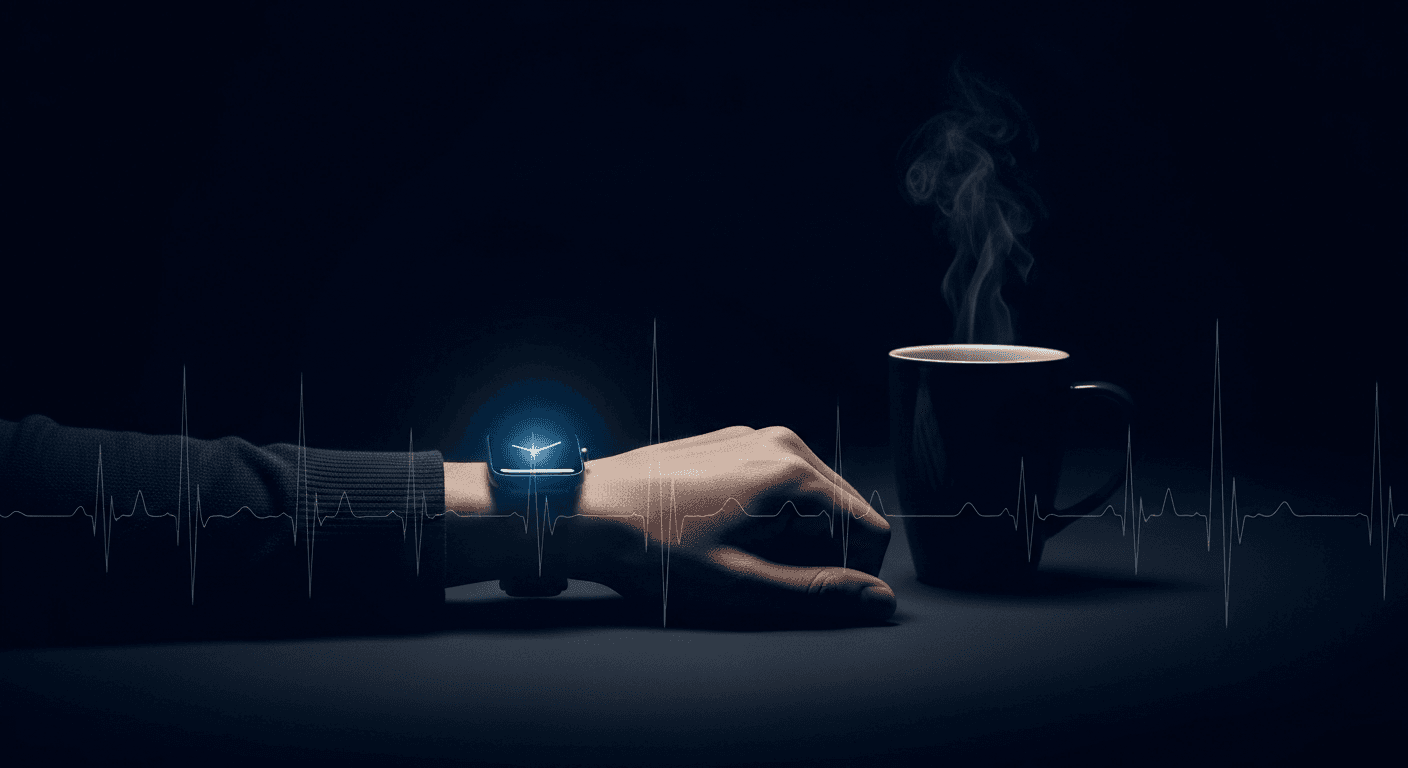
Your HRV falls when you climb stairs. It falls after coffee. It falls when you're dehydrated, fighting a cold, digesting a heavy meal, or standing up too fast. It falls hard during exercise. To the sensor, a flight of stairs and a brutal email can look almost identical. Same HRV dip. Same elevated heart rate. The device sees the dip and reaches for the nearest label: stress.
The mechanism is simple, and it's the same one every time. The score model has one job: take a physiological change and assign it a cause. But the body produces the same physiological change for dozens of reasons. Effort lowers HRV. Illness lowers HRV. Caffeine lowers HRV. The sensor sees the effect and has to bet on the cause, and with only one signal to go on, it bets wrong constantly. It never measured stress. It flagged that something changed and labeled the change stress, because that's the box the product was sold in.
Look at the raw stream and the ambiguity is obvious. A twenty-point HRV drop from a staircase and a twenty-point drop from a layoff call produce nearly the same waveform on a single channel. Nothing in that one channel separates them. The label is a guess dressed as a reading.
This is the core mechanism behind the false readings you've probably felt yourself. You finish a workout, feeling great, and the score says you're stressed. You're sitting perfectly still in a tense negotiation and the score says you're fine. You take a hot shower and the score spikes. You stand up from your desk and it jumps. The sensor works fine. It's blind to context, and a blind sensor will confidently mislabel half of what it sees.
Without context, a single physiological signal is ambiguous by definition. A drop in HRV is a question the device can't answer. One number can't tell you whether you sprinted or spiraled, and a device that can't tell those apart can't be trusted to tell you when to intervene. Worse, the misses teach you to distrust the hits. After enough wrong calls, you stop believing the number even when it's right.
Stress Score Accuracy Rests on a Moving Target
Most stress scores compare your current reading to a baseline. Sounds reasonable. The catch is that your baseline is never still.
HRV varies enormously between people. A healthy 25-year-old athlete and a healthy 50-year-old executive can have HRV numbers that differ by a factor of three, both completely normal for them. So the raw number is meaningless across people. There is no universal "good" HRV. It only means something relative to your own pattern, which means the score is only as good as the device's picture of who you usually are.
But your own pattern moves too. HRV shifts with sleep, age, training load, alcohol, hydration, hormones, and the season. The baseline a device calculated last month may not describe you today. Most consumer wearables update this baseline slowly, using a rolling average that lags behind your real state by days. A rolling average is built to smooth out noise, not to catch a trend, so a slow, sustained climb in stress looks almost identical to the new normal it was designed to absorb. The result is a score measured against a version of you that no longer exists.
It gets worse during exactly the periods you'd most want it to work. Go through a stretch of genuinely high stress like a launch, a bad sleep run, or a hard travel week, and the baseline quietly absorbs it. Your "normal" drifts toward your stressed state. After a week, the device recalibrates to the new normal and the score eases, even though nothing in your body has. The system adapts to your stress and then reports calm. The one time you needed the alarm, it learned to stop ringing.
> A stress score compared to a stale baseline measures one thing: how far you've drifted from last week's average.
This is why two people can do the identical thing and get opposite scores, and why the same person gets a different score on Tuesday than on Friday for no reason they can name. The number isn't lying on purpose; it's anchored to a moving target and reports the drift as if it were news. A measurement that depends this heavily on a baseline you can't see, calculated on a schedule you don't control, isn't a measurement you can act on with confidence.
Stress Has Timing, and a Daily Score Erases It
Even if the number were perfectly accurate, it would still miss the thing that matters most: when.
Stress accumulates as a sequence of moments, not as a daily total. It rises, it spikes, it compounds if nothing interrupts it, and it eventually settles. The damage lives in the spikes that stacked on top of each other through the afternoon because nothing broke the chain. Two people can end the day with the identical score. One stayed mildly tense for eight steady hours; the other was calm all day and then took three brutal hits back-to-back. Same number. Completely different days. The second person's afternoon is the one that does real wear, and the score can't see it.
There's a mechanism under that difference. The stress hormones released in a spike don't clear the instant the moment passes. They linger, and the next hit lands on a system that hasn't reset from the last one. So the third spike costs more than the first. A daily average treats all three as equal weight. Your nervous system doesn't, and neither should the read.
A score that summarizes your whole day tells you something happened. It cannot tell you when it happened, or catch it while it was still happening. By the time you glance at the screen and see a high number, the moment that produced it is hours gone. The information arrives after it's useful, like a smoke alarm that emails you a daily summary instead of going off during the fire.
And the moment is where everything is decided. A stress spike is easiest to interrupt in the first minute or two, before it compounds into the next one. Catch it early and a brief reset settles your system before the chain builds. Catch it at 9 p.m. on a screen, and all you've got is a report on damage already done. The window where you could have done something has closed.
This is the deepest limit of the stress-score model. It is built to summarize the past, not to catch the present. And stress is a present-tense problem. You can't intervene in a number, only in a moment, and the moment is exactly what a daily score throws away.
More Signals, Read in Real Time, Beat One Signal Guessing
The fix isn't a better number; it's more signal, read together, in the moment.
One input is ambiguous. Cross-reference several and the ambiguity starts to resolve. HRV plus heart rate plus motion plus sleep plus skin temperature, read together, start to separate the things a single signal blurs. Motion data knows you just climbed stairs, so the HRV dip gets read as effort, not stress. Sleep data knows you're running on four hours, so today's baseline adjusts. Temperature and heart rate together can flag the early hours of an illness, so the device doesn't mistake a fever for a hard week. Each added signal removes ambiguity the last one couldn't resolve on its own. The signals correct each other. That's the whole mechanism.
Context closes the rest of the gap. Layer in your calendar and your physiological dip during a 2 p.m. meeting reads differently than the same dip mid-run. Layer in your patterns over time, the way your body actually behaves before a stretch of pressure, and the read sharpens further the longer it runs. This is the difference between a number that describes you and a system that actually reads you. One describes and guesses; the other reads you, with enough signal to tell a sprint from a spiral.
And once a system can read the moment in real time, it can do the one thing a score never could: act inside it. Not summarize the spike after dinner. Catch it as it rises and intervene before it compounds, a brief haptic nudge on your wrist, a 1–2 minute reset, no screen to open and no number to interpret. That's the entire point. Detection that arrives too late to change anything is just a record. In the moment, it becomes an intervention. You can read more about how that detect-and-act loop works at momomoon.ai.
A score tells you how your day went. A real-time, multi-signal read tells you what's happening now, and does something about it before the next spike lands on top of the last one. The number was never the product. The intervention is.
Momomoon is the intelligence layer for your nervous system. It reads HRV and context signals from your Apple Watch, notices rising stress, and steps in with a 1–2 minute reset — before your day tips over. Free to download, and your first month of Momo is included.
Get new Journal entries when they’re published.
Field notes from the build. No marketing.